


Talking Tom: Hero Dash Run
Outfit7 Limited
Running through a bright city while dodging hazards is the whole appeal of Talking Tom Hero Dash, but I found that its real strength is how quickly it gives me a reason to try one more run. I can start playing almost immediately, understand the basic movement without a tutorial-heavy introduction, and then gradually become more interested in improving my route, collecting what is available, and opening more of the heroic cast. It is a free action game from Outfit7 Limited, aimed at Everyone, and it works particularly well as a short-session game for phones.
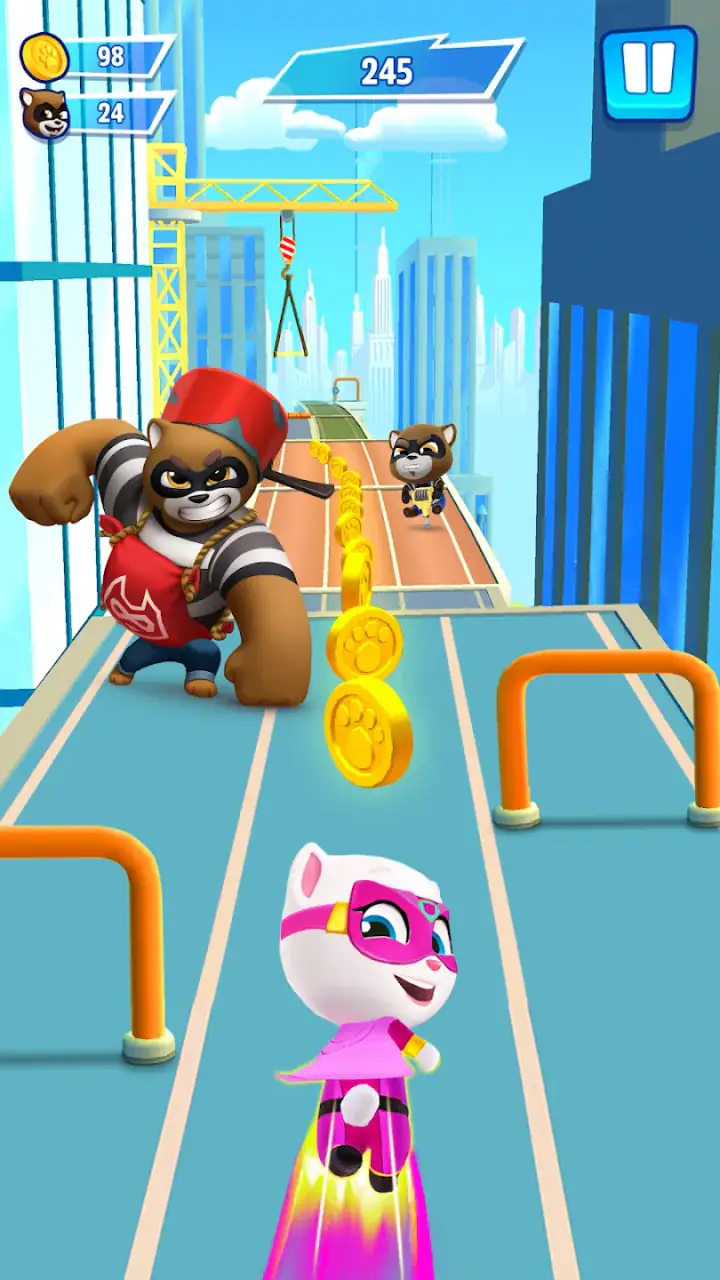
The central idea is simple: Tom, Angela, and their friends are trying to save the world, and I guide a character through an endless-style running challenge. The familiar Talking Tom presentation makes the game approachable, while the running format keeps the controls light enough for quick play. I do not need to learn a complex combat system or manage a large inventory before having fun. Instead, the game asks me to react, choose lanes, avoid danger, and keep the run alive for as long as possible.
That simplicity is also the first important trade-off. This is not an action game built around deep exploration, elaborate strategy, or a long story campaign. Its satisfaction comes from repeated attempts and small improvements. If I want a game that fits into a few spare minutes, that is a good match. If I want a large world with missions that feel completely different from one another, the familiar runner structure may feel limited after the novelty fades.
Related News

How the first runs establish clear goals
The opening experience is effective because the first goals are easy to understand. I am not left wondering what I should do next: stay on the route, avoid obstacles, gather useful items, and push farther. That clarity matters on a touchscreen, where the best mobile games often succeed by making the first minute feel natural. The controls are designed around quick swipes and immediate reactions, so I can focus on the path rather than on remembering button combinations.
Early goals also give the game a useful rhythm. A run begins with a straightforward objective, the environment presents a sequence of hazards, and the end of the attempt gives me a reason to start again. Even when I fail quickly, I usually understand what went wrong. I moved too late, committed to the wrong lane, or became distracted by a collectible. That readable cause and effect is one of the reasons the game is easy to recommend to younger players and casual users.
Related News

Why WhatsApp Messenger Still Makes Everyday Communication Feel Easy

Jurassic World: The Game Is the Better Dino Tycoon for Strategic Players

Threads in Real Life: Who Should Join, Lurk, or Leave

How SHEIN Turned Shopping Into an Endless Content Feed

How to Make Fortnite Feel Smarter on Mobile

Should You Switch to Microsoft Outlook on Mobile?
The characters help make those early goals feel more inviting than a completely anonymous runner. Seeing Tom, Angela, and the other familiar figures gives the action a recognizable identity, while the heroic theme adds a little more purpose than simply running for a score. I would not call the narrative the main attraction, but it provides a friendly frame for the repeated runs.
One useful habit is to treat the first few attempts as practice rather than as serious score runs. I found it better to watch how the route presents obstacles before trying to collect everything. New players often make the opposite choice: they chase every visible item and lose control of the character. Surviving a little longer teaches more about timing than grabbing one extra reward, especially when the route becomes busier.
Why the progress feels visible without being complicated
The game communicates progress through the things I can see changing around my play. Unlocking or using different heroes gives the repeated runs a sense of movement, even when the basic action remains familiar. That is important because endless runners can otherwise feel like a single challenge with a score attached. Here, the heroic cast and the world-saving setup give me a reason to care about continuing beyond my first few attempts.
Gallery
I also like that the progress loop does not require me to understand a dense set of menus. The appeal is immediate: play, improve, and work toward the next visible goal. That makes it suitable for a child who wants to play independently, although younger users may still need an adult to explain purchases and decide whether spending is appropriate.
The progression is most satisfying when I use it as a personal improvement tool. Rather than asking only whether I have unlocked something, I compare how calmly I handle the same type of obstacle from one attempt to the next. This turns a simple run into a small skill exercise. I learned to keep my attention on the route ahead instead of reacting to the last hazard, and that change made more difference than trying to move constantly.
A second practical tip is to avoid judging a character or reward solely by how exciting it looks when it appears. The useful question is whether it changes the way I want to play or simply gives me another reason to continue. For players who enjoy collecting familiar characters, that alone may be enough. For players seeking dramatic mechanical variety, the unlocks may not transform the game as much as a new level or a new genre would.
The difficulty curve rewards attention, not complicated planning
The challenge comes from maintaining concentration as the run continues. At first, the route gives me enough room to understand the movement. Later, hazards and choices demand faster reactions, and a small lapse can end an otherwise good attempt. The difficulty therefore feels less like a puzzle that I solve once and more like a test of consistency.
I appreciate that design because it keeps the action accessible. I can play without studying a guide, and I can tell when I am improving. The downside is that difficulty in a runner can eventually feel repetitive. The basic skill remains reaction and lane management, so players who prefer varied combat or tactical decisions may reach their limit sooner than fans of arcade-style repetition.
My best approach was to separate safe movement from ambitious collecting. When the route becomes crowded, I prioritize staying alive and only take a risky item when the path is clear. This sounds obvious, but it changes the game from frantic swiping into a series of small decisions. It also makes the challenge feel fairer, because failure becomes connected to a choice rather than to random panic.
The game is a better fit for touchscreens than many traditional action games because the controls do not demand precision aiming or several simultaneous inputs. Still, screen size matters. On a smaller phone, my finger can obscure part of the route at the exact moment I need to react. I found that playing with the device held steadily, rather than shifting it between hands, reduced accidental movements.
What keeps the loop going, and where it can become tiring
The strongest retention tool is the short retry cycle. A failed run does not feel like a major setback, so I can immediately try again with a different approach. That works well during a commute, while waiting for an appointment, or during a brief break when I do not want to commit to a long story game. A single session can be casual, but repeated sessions can still become focused once I start chasing better performance.
There is also a natural emotional pull in trying to reach the next visible milestone. The combination of familiar characters, bright presentation, and quick restarts makes the game easy to return to. In my experience, the most convincing reason to continue is not a complicated reward structure; it is the feeling that the next run might be the one where I finally handle a difficult section cleanly.
That same loop can create retention pressure. Because the action is built around repetition, I may keep playing after the fun has started to flatten simply because another attempt is so easy to begin. The free entry point lowers the barrier further. The game costs nothing to start, but in-app purchases range from $0.99 to $114.99 per item, so I would recommend checking purchase controls before handing the phone to a child.
This is not a criticism unique to this title, but it matters when deciding whether it belongs on a family device. The Everyone age rating describes the intended content level, not a guarantee that every player will manage spending or screen time sensibly. I would treat the game as a supervised entertainment option for younger children, especially if the device stores payment details.
Another limitation is that the runner format does not suit every mood. When I want a relaxing game, the need to react quickly can feel more tiring than entertaining. When I want a deep challenge, repeated routes and familiar actions may not offer enough variety. A puzzle game is better for deliberate problem-solving, while a larger action adventure is better for exploration and story. This title sits firmly between those choices: more active than a casual puzzle, but much lighter than a full adventure game.
A realistic everyday use case
Imagine having ten minutes before a train arrives. I can open the game, complete a few runs, and stop without losing the thread of a long campaign. If I fail, the restart is immediate enough that the short session still feels worthwhile. If I do well, I leave with a clear personal achievement rather than needing to reach a chapter ending.
For a parent, that same situation can work differently. The game is easy for a child to understand, and the colorful heroes make it inviting, but I would first check the device settings and explain that not every tempting item needs to be purchased. I would also set a stopping point before the first run, because the quick retry design makes “one more attempt” especially easy to say.
For an adult player, I see it as a compact arcade game rather than a main gaming destination. It is useful when I want action without a long setup, and it is less suitable when I am looking for a substantial evening experience. That distinction helped me enjoy it more: I stopped expecting it to become a different kind of game and judged it on how well it handles short, repeatable runs.
How it compares with other mobile action choices
Compared with a traditional platform game, this runner offers less control over exploration but gets me into the action faster. Compared with a competitive action title, it avoids the pressure of playing against other people and lets me improve privately. Compared with a puzzle game, it demands quicker reactions and rewards timing more than careful planning.
Its recognizable characters are another point of difference. Many runners rely almost entirely on speed and obstacles, whereas this one uses the Talking Tom cast to make the experience feel more like a light heroic adventure. That will matter most to players who already enjoy those characters. If I have no attachment to them, the game still works, but the presentation may not add as much value.
The trade-off is depth. A more advanced action game may offer richer abilities, more complex encounters, or stronger long-term variety. I would choose this game instead when convenience and accessibility matter more than breadth. It is a good first action game for someone who dislikes complicated controls, but it may not satisfy a player who wants mastery built around many different systems.
Who should play it and who should skip it
I think it is a strong choice for casual players, fans of the Talking Tom characters, families seeking an approachable action game, and anyone who enjoys improving through repeated short attempts. It also suits older phones reasonably well in principle because it supports Android 6.0 or later, making it available to users who are not carrying the newest device.
I would skip it if my priority were a substantial storyline, open exploration, competitive multiplayer, or a game that changes dramatically from one session to the next. I would also be cautious if I dislike in-app purchase prompts or tend to play longer than intended once a retry loop becomes engaging. The free download is convenient, but the surrounding purchase options mean it deserves the same basic spending awareness as other free-to-play games.
Its broad reach is reflected in a 4.3 average from around 2.1 million ratings and over 500 million installs. Those figures suggest that the accessible formula has connected with a very large audience, though popularity does not remove the personal question of whether repeated running is your kind of action. I found the game enjoyable when I wanted a quick, colorful challenge, not when I wanted a deeper adventure.
My verdict on the progression and pacing
The progression works because it gives the simple runner loop several layers of motivation: immediate survival, personal improvement, familiar heroes, and visible reasons to continue. The pacing is quickest at the start, then becomes more demanding as concentration matters more. I like that the game does not force me to master a complicated system before enjoying it, but I also recognize that its long-term appeal depends on whether I enjoy repeating a core action.
The most important advice I can give is to play deliberately. Learn the route before chasing every collectible, treat each failure as information, and decide in advance how long a session should last. Those habits make the game feel more skill-based and reduce the chance that the retry loop controls the session instead of the player.
Outfit7 Limited has made an approachable action game that uses its characters well without burying the player in complexity. The best reason to play is its balance of instant access and small, satisfying improvements. The main reason to look elsewhere is the limited variety inherent in a repeat-run format. For short breaks, family-friendly action, and fans of Tom and his friends, I would recommend giving it a try. For players demanding deep systems or a long-form campaign, I would choose a different kind of game.
Overall, I see Talking Tom Hero Dash as a polished pick-up-and-play runner with a clear audience and an honest limitation. It sustains interest through goals and pacing rather than through complexity, and that is exactly why it feels welcoming. As long as I keep my expectations focused on quick action, gradual progress, and replayable challenges, it delivers a fun mobile experience without asking me to learn more than I need.
FAQs for Talking Tom: Hero Dash Run
What is Talking Tom: Hero Dash Run all about?
Talking Tom: Hero Dash Run is an action-packed endless runner game where players help Talking Tom and friends save the world from raccoon invaders. You'll dash through vibrant environments, collect coins, and unlock new characters with unique abilities. The game combines fun, strategic gameplay with engaging missions and rewards.
Do I need an internet connection to play?
Talking Tom: Hero Dash Run can be enjoyed offline, allowing players to run through levels without an internet connection. However, certain features, like in-game events, leaderboards, and updates, require an internet connection to access additional content and compete with friends.
Are there in-app purchases, and are they necessary?
The game includes optional in-app purchases that allow players to buy coins, gems, and special items. While these can enhance gameplay and speed up progress, they are not necessary to enjoy the full experience. Players can complete missions and earn rewards through regular gameplay without spending real money.
How does the game ensure a child-friendly experience?
Talking Tom: Hero Dash Run is designed to be family-friendly, with colorful graphics and easy-to-understand mechanics. The game includes parental controls and offers a safe environment for children. Ads are limited, and in-app purchases can be restricted with parental settings to ensure a secure gameplay experience.
What devices are compatible with Talking Tom: Hero Dash Run?
The game is available for both Android and iOS devices. It requires Android version 4.4 or later and iOS version 9.0 or later. It is optimized to run smoothly on most smartphones and tablets, ensuring a seamless experience across a wide range of devices.
Pros
- Engaging gameplay keeps you entertained.
- Colorful graphics appeal to all ages.
- Easy controls make it accessible for beginners.
- Frequent updates with new content.
- Fun missions and events enhance replayability.
Cons
- In-app purchases can be expensive.
- Requires a stable internet connection.
- Ads can be intrusive during gameplay.
- Can be repetitive over time.
- Some features need real money to unlock.


